reabc/Voices of the Lucasville Uprising Volume 1/Voices of the Lucasville Uprising Volume 1.pdf
Web PDF • Imposed PDF• Raw TXT (OCR)
![’ 15 was a rebellion against oppressive ies at the Southern Ohio Correctional in Lucasville, OH. Nine inmates and one G the uprising in April of 1993. Today, secple are serving time or condemned to death by the of Ohio in relation to the uprising. We demand y and freedom for all of these inmates. The (and still are) intolerable and onditions at SocF inconscionanle South Chicago ABC ;i Zine Distro distributed by: ‘l P.O. Box 721 =y RE D BI 21) Homewood, IL 60430 St PO BOX 1291 Columbus Oh 43216 ] PRISO redbirdprisonabolition.org ibutors this zine do mot support the various alleged 2ffiliations of the prisomer contributors to this but strongly support their stand against government and will do what we can to amplify their shown by prisoner resistance nationally there ok past individual beliefs and alleged to stand together. Unity takes away the lay puppet masters and places = enlightened prisoners who choose not These prigoners’ united stand across ns and under the most trying of uld be an sxample and inspiration to us FREE ALL PRISONERS The aistr](Voices of the Lucasville Uprising Volume 1 24.png)
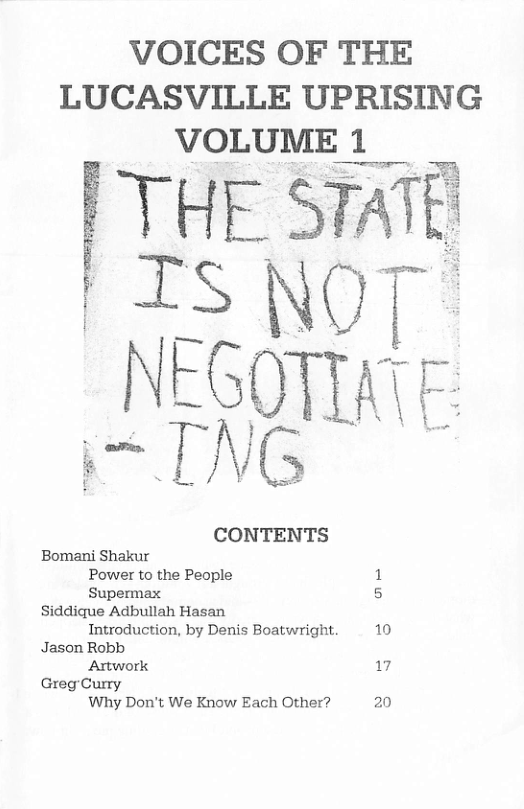
VOICES OF THE
LUCASVILLE UPRISING
VOLUME 1
gTHEmfifi
TS NQ
NFGO ts
FRAE
CONTENTS
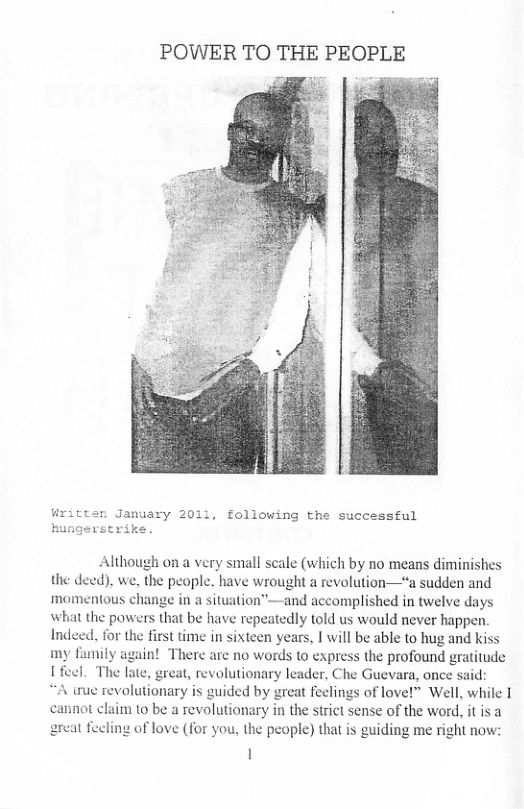
POWER TO THE PEOPLE
Although on a very small scale (which by no means diminishes
the deed), we, the people. have wrought a revolution—*a sudden and
momentous change in a situation”—and accomplished in twelve days
what the powers that be have repeatedly told us would never happen
Indeed, for the first time in sixteen years, | will be able to hug and kiss
fumily again! There are no words to express the profound gratitude
he late, great, revolutionary leader, Che Guevara, once said:
“A truc revolutionary is guided by reat feelings of love!™ Well, while I
cannat claim to be a revolutionary in the strict sense of the word, it is a
cling of love (for you, the people) that is guiding me right now:
even as | write this, tears of hope and determination are strcaming down
my face.
‘When one has been forced to live in a space no larger than a
closet for sixteen years, 23 hours a day. not only does one begin to fecl
extremely insignificant, but the very world begins to shrink; and
everything, even the smallest thing, seems impossible. Hence, never in
my wildest dreams could I have imagined the overwhelming outpouring
of love and support that came flooding into my cell after I cried out for
help. People from all over the country and the world—England,
Ireland, Serbia, Amsterdam—reached out and joined together with us to
ight an injustice; and surprisingly, miraculously, we succeeded!
Everything we demanded was properly handed over (see attachment).
It would be great if I could say that the worst is over now, and
that, with victory in hand, I can live happily ever after. Unfortunately, |
don’t have the luxury of living in a fairy tale; the people who are trying
o take my life are real, not a figment of my imagination. In fact, not
even a week after my piece—If We Must Die—was posted and we
embarked on the hunger strike, a federal district judge tumed down my
appeal, which placed me even further in the balance. It would be naive
of me to believe that this was just a coincidence, an unrelated incident
that just so happened to coincide with our peaceful, nonviolent
demonstration.”As you may recall, I said some very harsh things (all of
them truc) against the system; and I say them again: this system is
bogus and sold to those with money. In other words, if you don't have
the capital you get the punishment, and justice, like everything else in
this capitalist nightmare, is nothing more than a commodity that is
reserved for the highest bidder. Need I say more?
Friends, [ beg you not to abandon me to this mockery; inasmuch
asmy life is not for them to take, I intend to fight them, and | (we) need
your help. What they did to us can not stand up under the bright light of
scrutiny. Because of who we are, they felt that doing a thorough job
wasn'tnecessary. After all, who's going to give a damn about a bunch
of criminals? With this as their attitude, they utilized a “first-come-
first-served” strategy and ended up charging several different people
2
with the same crimes, using different theories: and, in some cases,
allowed the actual perpetrators to point the finger elsewhere if they were
willing to assist the prosecution in cleaning up its books. Simply put,
what they did to us is a travesty of justice; and yet, our convictions have
remained intact through the lower courts of appeal and are quickly
making their way through the federal courts. In other words, if we don’t
do something to get out in front of this thing, they are going to kill us
soon. And it may be that, no matter what we do, they are going to kill
us anyway. Well, okay. Butif that be the case, let us at least make sure
that they not be able 1o call it justice. [f they kill us, let us at least be
able to call it what it really is: murder.
Friends, we don’t have to accept this; we don’t have to continue
down the path of least resistance, allowing them to do with us whatever
they please. If we stand together and speak truth to power, they will
have no choice but to right this wrong. They did it in the current
confrontation, and they will do it again, not because they want to but
because they have to. Whenever hypocrisy is confronted by the truth, it
must capitulate. Therefore, the key to fighting these people is to expose
the truth and then hold it up next to what they claim o represent. If we
can do this well enough, they will either have to practice what they
preach or, as Malcolm X suggests, preach what they practice. Our job
is o make sure they don’t have it both ways.
Our friend, Staughton Lynd, has written a book about the
uprising (Lucasville: The Untold Story of a Prison Uprising), and we
need to encourage people to read it. In the coming days, weeks, and
manths, we need to formulate plans to reintroduce the play and launch
the documentary, Dirty Little Secrets, all with the intended purpose of
making as many people as possible aware of what actually happened
dusing the uprising and its afiermath. Ultimately, the goal is to
compose a petition, similar in scope to the ones that were recently
reulated, which will then be presented to the govemor with the
demand that he cither issuc a general amnesty with respect to all of the
Lucasville cases or, in the aiternative, convene a panel of qualified
experts o determine whether or not a general amnesty is warranted.
In closing, I want to thank each and every one of you for comi
forward as you did. | am both humbled and uplified by the support
When I phoned my eight-year-old niece, Kayla, afterwards and
informed her that “uncle Keith will be able to touch her little hand
soon,” she, with excitement brimming in her voice, said, “that’s
awesome!” And I couldn't agree with her more: what we did was
awesome! We came together and spoke truth to power and won'!
Imagine that!
Power to the People!
9 P ya
L
A2
Bomani Shakur
/" aka Keith LaMar
January 2011
SUPERMAX
Bomani Shakur
According (o the Department Of Justice, the word "supermax” is
defined as "a highly restrictive, high-custody housing unit within a
secure facility that isolates violent inmates from the general
population.” Sounds simple enough-- that is, until one delves into the
true meaning of the word; then, of course, things tend to get a bit more.
complicated. I¢s difficult to know, for instance, what the human cost
and consequences will be. There have been studics, and all paint a very
disturbing picture of the psychic damage that this kind of isolation can
inflict. Indecd, although the term is relatively new, the idea behind the
supermax is not a new conception. It has been tried before, and the
prevailing wisdom of the time demanded that human beings, including
the most hardened criminals, be treated humanely and not tortured. But
we as a society have, traveled far beyond the times when those on the
“inside” were thought of as human beings; hence, what is done inside
these places s of little or no concern to those on the “outside.”
n his poignant picce on crime and punishment, Kahlil Gibran
posed the question, “What penalty lay you upon him who slays in the
flesh yet is himself shain in the spirit?" As human beings, we are taught
0 believe that there is such a thing as good and bad people, and even
though we know from our own experiences that life is very seldom that
sitaple, we allow ourselves to believe in this because it allows us to live
more comfortably within the shelter of our own illusions.
The rapist who was molested as a child, the murderer who was
bullied. the thief whose childhood was stolen; we don't become who we
are on our own. At certain stages in our development we are vulnerable
10 various imprints, pivotal experiences that stamp themselves on our
psyches and form for us a self-concept. And self-concept is destiny.
T lock someone up and throw away the key is the easicst way
10110 see the truth. And what is this truth that is so shameful, S0
scundalous, that the prison population in the United States has surpassed
million? At some point we have (o stop and ask ourselves what is
being hidden away inside these places. We hear terms like “the worst of
the worst'and blindly assume that we are heing told about the worst
murderer, the worst drug dealer, the worst rapist, etc. It never really
dawns on us that the framers of the term, are. in actuality, talking about
the worst human beings: the ones who just couldn't cut it (so to speak)
re,
Yes, there are murderers here, but they aren't the same kind of
Killers that are sent to Iraq. There are drug dealers here as well, but, as
far as | know, none of them owned the planes that brought the drugs
into America. And, yes. unfortunately, there are rapist here, too. but
only a few fit the description that is portrayed by the media. In point of
actual fact most of them are victims of some type of rape or molestation
themselves and, as perverted as it may be, were pursuing a patter
was forced upon them. These are not evil people. I've talked to them; |
know their stories. The vast majority of those who are thrown into these
places are shattered beings, people who lack the nervous equipment
necessary to survive under the cutthroat competition of a capitalistic
society.
When we hear the word "criminal” we think of someone who
has been found guilty of a crime. However, for the purpose of the
present writing, I like to suggest that guilt and responsibility are two
very different things. For example, a person can be guilty of selling
drugs but not at all responsible for creating the conditions wherein
selling drugs is a viable option of survival. Indeed, when one lives in a
country where profit takes precedence over human potential and almost
all of the "legal” avenues to security have been blocked in order to
create more wealth for the rich, one’s very existence becomes a crime:
and whether this takes on the form of prostitution, selling drugs, or
stealing cars, the goal in every instance is t0 stay alive. This does not
make one a bad person.
I living in the freest country in the world demands that larze
portions of the population be sent to prison. then there's something
missing in that freedom. Likewise, if being the wealthiest country in the
world means 50 percent of all the wealth and resources have been
hoarded by the wealthiest 1 percent, while 30 million people live belov
6
the poverty line, then there’s something criminal in that accumulation. If
the United States is the freest and most wealthy country in the world,
there shouldn't be 2.5 million people behind bars (not to mention the
‘millions on probation and parole), and there most certainly shouldn't be
aneed for supermax prisons.
In his essay on “Capitalism and Incarceration,” Richard D.
Vogel points out that, “the widespread practice of mass incarceration is
a result o the deindustrialization of the nation during the past twenty-
five years and the consequent social and economic dislocation that
disproportionately impact minorities.” In thinking about this, we can
begin (o understand why so many people have been left for dead in a
kind of cconomic no-man's-land where, in order to survive, "altemative
economies" (to borrow a phrase from Angela Davis) have had to be
created. Under the current social structure, then, prisons have become
the "dumping grounds” for the poor and no-longer-needed. Indeed, it
wouldn't be extreme to compare what is happening now with what was
happening in Germany (1940s) when Hitler was rounding up all the
Jews and throwing them into concentration camps. The only real
difference (and it's a very clever difference, [ must say) is that those
who are presently being thrown away are considered criminals which,
let's face it, makes it a whole lot casier to accept. But just as Hitler
created the justification for the mass incarceration of the Jews, 50, t0o,
has the U.S. government, through systematic deprivations, created the
justification for the mass incarceration of the poor. The analogy is
perfect.
It was during the Regan-cra (1980s) that we began to see the
deindustrialization of the nation and the subssquent proliferation of
prisons across the American landscape. And to fil these prisons, the US
government allowed huge amounts of cocaine to be dumped in to the
inner cities (DARK ALLIANCES by Gary Webb). Sounds crazy,
doesn'tit? The US government would never do something as sinister as
this; and we believe this, eve though we know about slavery and what
happened (o African Americans in this country; we believe this, even
though we know about Japanese internment, and the almost total
anaihilation of Native Americans. But that's just the thing, according to
7
Noam Chomsky: "If you have been ‘properly educated', you can't
understand facts like these: even if the information is right in front of
your eyes, you won't be able to comprehend it." And yet, the math tells
the story.
The total adult population under correctional control exceeds 6.6
million. Between 1982 and 1997, expenditures on corrections increased
a whopping 381 percent, police cost jumped 204 percent, and
disbursements for judicial functions expanded 267 percent. Total direct
spending on the criminal justice system in the United States (during the
Regan-Bush-Clinton era) rose by 262 percent. The total outlay for
criminal justice in 1997 approached $130 billion. (Richard D. Vogel)
‘These numbers reflect the maximurm utilization of the criminal
justice system as a weapon of class warfare, as funds have been
siphoned away from social services and education and reallocated to
support the expansion of the prison-industrial complex. In other words.
we have arrived at a crossroads, at a point in human history where we as
individuals must decide whether or not we are going along for the ride
o going to stand up and speak truth to power. Howard Zinn said. “You
can't be neutral on a moving train.” Well, this train is moving, my
friend, and the supermax prison is but a signpost to indicate where we
a5 a nation are going. Its a preparation, then. a moral gut check (if you
will) to see if the U.S. citizenry is willing to sit back and allow the
virtual entombment of its fellow citizens. And so far it doesn't took
good.
Instead of addressing the issues that create the conditions that
spawn poverty and violence, those in a position to speak have conspired
‘with those in power and decided to blame the victims for their own
‘victimization. In the meantime, the United States has the highest
incarceration rate in the world, and one of the highest of any country in
history.
When future generations look back on this era of human
disposal, they are going to wonder how did this happen. how did so
‘many “good people” sit back and allow those who crave money and
8
power to repeat a history that had already been proven to be faulty. And
we are going to have 10 tell them that we were affaid, that we allowed
our fear and cowardice to dominate our decisions.
And for those of you who feign ignorance and pretend not to
know what s really going on while you live lives of luxury, I say to you
in the words of Francis Jeanson: “If you succeed in keeping your hands
unsullied, it is because others dirty themselves in your place. You hire
thugs, and, balancing the accounts, it is you Who are the real criminals:
for without you, without your blind indifference, such men could never
carry out deeds that damn you as much as they shame those men.”
oxee
As | write this, I'm sitting inside a cell at the Ohio State
Penitentiary. listening to the strange sounds of those who, like myself,
have been discarded by humanity. The majority of them are watching
the football game, oblivious to the fact that their days, like mine, are
numbered. Every now and then | hear a scream, but, since the game is
o, it’s difficult to know, from whence it came: the game, the pain, or
the constant strain they are under. | hope it's the game, but I know
better. [ know what this experience has done to them; some of them will
never be the same again. And not all of them are doing forever; some of
them will be going home soon, retumning to a community near you,
broken and battered... and ready to o violence!
WRITE TO BOMANI :
Lamar 317-117
Ohio State Penitentiary
878 Coitsville-Hubbard RA
Youngstown OH 44505-4635
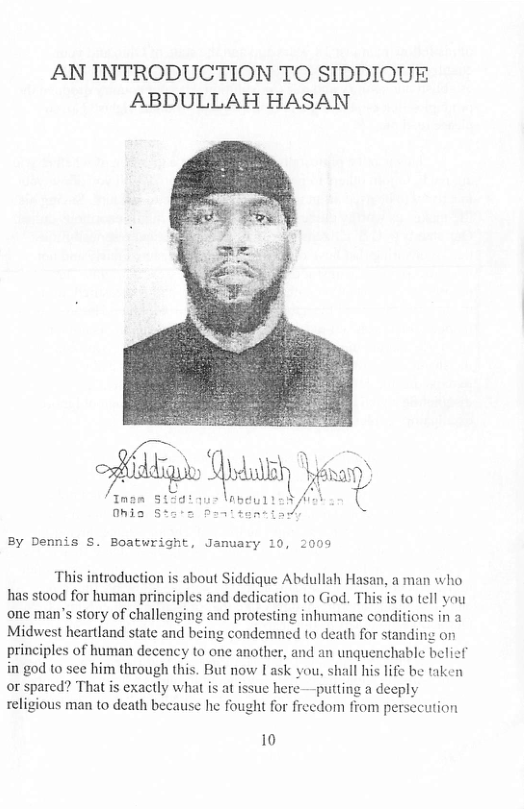
AN INTRODUCTION TO SIDDIQUE
ABDULLAH HASAN
ohia
By Dennis S. Boatwright, January 10, 2009
“This introduction is about Siddique Abdullah Hasan, a man who
has stood for human principles and dedication to God. This is to tell you
one man’s story of challenging and protesting inhumane conditions in a
Midwest heartland state and being condemned to death for standi
principles of human decency to one another, and an unquenchable belict
in god 10 see him through this. But now I ask ou, shall his life be taken
or spared? That is exactly what is at issuc here —putting a deeply
religious man to death because he fought for freedom from persecution
0
of his fellow man just 18 years ago and the state of Ohio and your
country want to put his life to an end for the same principles that
establish our country and our Constitution. Has our country dropped the
principles that establish it and made it great—human rights? No, so
please read on.
This is not a philosophical matter. It is a question of whether you
arc ready to join others to help free lmam Hasan, or will you allow your
inactivity to be used as an instrument of the state to kill him. Saving his
life makes us worthy citizens, a sacred title that entails enormous duties.
Our claims to U.S. citizenship comes with sacrosanct responsibilities;
that is, ensuring that laws of this land are administered fairly and not
jously used against those presumed to possess no rights. Our
pairiotism is constantly challenged and tested, and is measured, in part,
by how we safeguard the spirit of the Constitution. Imam Hasan is an
inuocent man. It is our patriotic duty to make sure his life is not cut
short. His exoneration is our freedom, in that it frees our conscious of
the shameful guilt that would forever trouble our minds had we
remained neutral. Our collective voice and efforts will send a
disquiting signal to the criminal justice system that it cannot ignore
exculpatory evidence in the Imam Hasan's capital trial.
Supporting Imam Hasan's case is not merely about freeing an
innacent man, his plight and case has much broader and lasting
implications to our society and future generations. We are not only
saving the life of an innocent freedom fighter, but also protecting a
special legacy that runs through the likes of Thomas Paine, Frederick
Douglass, Malcolm X, George Jackson, leading up to Imam Hasan. He
represents an endangered species of man whom we cannot allow to fall
into extinction. Will Imam Hasan live or will we allow his life to be
ended tragically and prematurely like that of Martin Luther King, Jr.?
Our actions hold part of the answer.
ous people like Imam Hasan are rare occurrences. They
illion, once-in-a-lifetime. individuals whom many only
¢t 10 know through reading books. The most amazing characteristic
about Imam Hasan is how resolute and dignified he has been since
being sentenced to death. Most would respond differently.
When confronted with overwhelming odds or impe:
‘many people will moderate their stance or tone down their hetoric
within the logic of self-preservation. This change can be swifi or streteh
across an entire lifetime, or span one’s academic or professional career,
depending on the dimension of the threat. In the realm of politics and
social movements, this transformation can be most astonishing and
dramatic, sometimes occurring instantancously, overnight or after (he
p latest Zogby opinion poll. The more sudden of these transformations are
usually explained away by beneficiaries of the status quo as an
intelligent response to danger. Supporters of this view often
conveniently discount the precursors to this unexpected conversion (o
bolster their claims that the chance occurred without external pressures,
i.e., as the result of innate human pragmatism. But since time .
immemorial, threats and looming danger have proven to be powers
influences that help decide the basis of one’s behavior. This makes
sense, considering that the outer environment causes individuals
respond accordingly, in many cases without regard to preexisting
convictions. A few common examples will elucidate this point.
Some facing summary execution or long-term imprisonment vill
modify their posture in favor of interrogators in an effort to save their
own lives, even if their betrayal comes with an unconscionable price—
¢ destruction of organization or certain death of key members. Ancthe:
© example of induced change occurs when a former dissident
. intellectual’s tenure is endangered by university regents because of
outspokenness, or the professor is offered a more lucrative post withi
another institution wherein the educator is expected to align his/her
political philosophy to mainstream expectations. A final illustrztion is
that of politicians, people whose livelihood and quest for power and
prestige rely heavily upon voters and taxpayers. Opinion polls and
public perception cause many “pragmatic” public servants {0 canpaigi
against their own position, switch political parties. or oppose dez:
policies when politically expedient to do so. Ther are plerity of
examples that fit into this parasitic category. In the praxis of
12
or seeking career advancement find
it easy 0 compromise their stance. Conversely, there are others whose
position remains constant no matter the enormity of the threat. No
amount of reward or punishment can cause them to cave in or violate
principles they stand on, because to do so would entail a fundamental
restructuring and reevaluation of their own value system. But there are
fes who not only remain firm in their position, but who actually harden
their position commensurate with the degree of danger. It is learned that
this exceptional group has predetermined that hardships and dangers
inevitable will be encountered for exposing views out of favor with
those possessing coercive power. Still there are even fewer who actually
ratchet vp their denunciation of injustice upon facing inescapable peril,
even while being driven (o the gallows. They manage to maintain their
defiance and dignity until their last breath when most of saciety would
find it extremely difficult to hold together. This defiant composure is
remarkably illustrated by a captured rebel slave, informing his captors
who asked what he had to say during the “trial”
“1 have nothing more to offer than what General Washington
would have had to offer, had he been taken by the British officers and
putto trial by them. I have ventured my life in endeavoring to obtain the
liberty of my countrymen, and am a willing sacrifice to their cause; and
I ask a favor, that | may be immediately led to execution. I know that
‘you hav ermined to shed my blood. Why then all this ‘mockery of
a tial
o act with extraordinary dignity and to speak with penetrating
clasify while facing imminent death is Something to marvel. But, most
people will reflectively change their position when facing a
demonstrative ending. Not so Imam Hasan,
Imam Hasan is among a small percentage of people who do not
suceum’ (o human capriciousness. He is an embodiment of fearlessness
and forbearance in the face of savage consequences. He has been sitting
13
on death 0w, in solitary confinement, since he was convicted of being
the mastermind of the deadly 1993 Lucasville prison uprising which
ended in the deaths of ten people, including one prison guard. Since
then, lmam Hasan has been sequestered in the most harrowing
confinements, virtually without human contact; all the while a looming
death sentence shadows his existence. Despite living under an
unmythical sword of Damocles, Imam Hasan displays a mystifying
calmness that continues to baffle, as well as inspire, this writer and
numerous supporiers, especially his loving wife, Saadiqah, and his
stepdaughter, Nadia, who find it easy to carve a smile on the face of this -
. very serious yet compassionate man. Condemned to death row has ot
caused a qualitative decline in his dedication to Allah (God), nor the
; beliefin the moral legitimacy of his actions. In fact, Imam Hasan has
not budged from his principled stance to try to curry leniency from his
tormentors. His ordeal has only caused his obedience and faith in God
o ever increase. The Imam has kept his composure, and s not only
putting up a gallant fight (o save his own life, but he is endeavoring
- mightily to change legislation that may help save the lives of others,
"This point is not a trivial notation. Most people’s faith suffers decline in
trying circumstances, to the extent that they wonder about the very
existence of God, or the legitimacy of the Cause they are being
persecuted for. Specifically, they question why Divine help is fot
around when it is needed most.
Not unlike many other great thinkers and leaders, lmam Hasan is
aman before his time; a throwback to the 60 form of direct radical
progressivism. Had the ethos of that day been present today, lmam
Hasan would be heralded as a hero within certain segments of U.S
society. Unfortunately we are in an age of undiscovered purposes.
wherein no one seems to stand for anything or know what to stand for; a
time wherein bluster is confused for substance and authenticity. This
confusion allows for many pretenders—that i. people who place o
limits on promoting their self-interest—to pass as real leaders. These
putative grassroots leaders, had they been in Imam Hasan’s situation.
‘would say or do whatever the authorities wished to save themselves.
They would not hesitate to disavow their own principles, or shamefully
14
throw themselves on the mercy of the court. Those who visit or speak to
Imem Hasan detect no signs of capitulation.
Imam Hasan has been described as a monster by mainstream
media. He has been falsely blamed for starting that bloody prison
uprising. Corrections staff do not want the public to know that
oppressive prison conditions cause riots to flare up. Deplorable prison
conditions at the Southern Ohio Correctional Facility catapulted Imam
Hasan into our lives. Had prison conditions not fell below human
toleration. we may not have been introduced to Imam Hasan under such
violent circumstances. But this supposition goes without saying. We can
also surmise that, had Britain not insisted that America remain one of
her colonics. or had Western nations not enslaved people of color, we
would never have know George Washington, Nat Turner, Gandhi, nor
Ho Chi Minh. The social physics of human interaction dictates that
heroes. statesmen, and the great thinkers are spawned from the throes of
resistance. These extraordinary personalities seem to have a flair for
crisis management and a reassuring calmness when mere mortals are
engulfed by panic. For this is why we place them such high pedestals.
. Ironic as this may sound, peace-loving people whom we have grown to
revere are most often by-products of war and struggle. Many of our
heroes have fallen on the battlefield. But their military failure does not
stop their courage from enchanting the hearts and minds of those who
know o victory, but who understand and respect their sacrifices. The
hero of this article is alive, and there is a movement underway to keep
living.
In conclusion, this web page (http://www facebook com/siddi
que.hiasan) s not for curious web browsers excavating for prison
oddities for cntertainment. It is a page/site that presents the facts in
Imam Hasan's case and introduces visitors to an incredible person
whom the statc of Ohio is bent on executing, despite exculpatory
evidence. He represcnts the last of a dying breed of men; people who
stood up for truth and justice for those who are less assertive, knowing
that they may not realize the fruits of their efforts in their lifetimes.
Visitors to this page/site are commended for their curiosity and
courage for daring to read its contents. You are the special people who
make legendary people great, because without your support, they would
not be able to do the things that succeeding generations honor them for.
‘This is only the introduction to a source that is full of fascinating
information, charts, and audio and written commentaries of lmam
Siddique Abdullah Hasan. What follows guarantees to fascinate as well
as intrigue readers. This is a rare chance to enter the mind of a freedom
fighter (0 get a better understanding of the thoughts of the likes of
Malcolm X and George Jackson. Hopefully all of the forthcoming pages
will clear up any misconceptions you have of his case, and this new
information will encourage you and others to join in obtaining his
freedom. As alluded to above, one of the most saddening aspects of
history is the fact that most great men and women are scomed and/or
unappreciated during their own lifetime. Edification and admiration
usually come belated, years after they have passed away. We are trying
o reverse this tend.
WRITE TO HASAN:
siddique Abdyllah Hasan
R150-559
Ohio State Penitentiary
878 Coitsville-Hubbard rd
Youngstown, OH 44505-4635
16
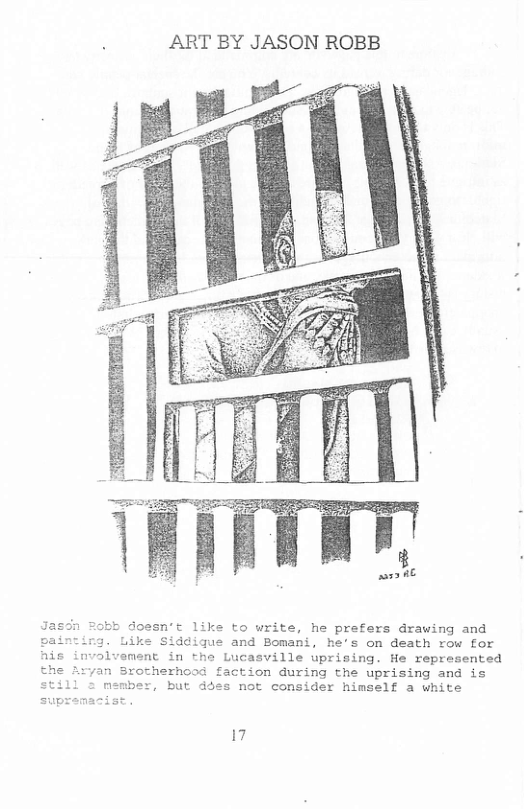
ART BY JASON ROBB
write, he prefers drawing and
d Bomani, he's on death row for
sville uprising. He represented
n quring the uprising and is
ot consider himself a white
17
18
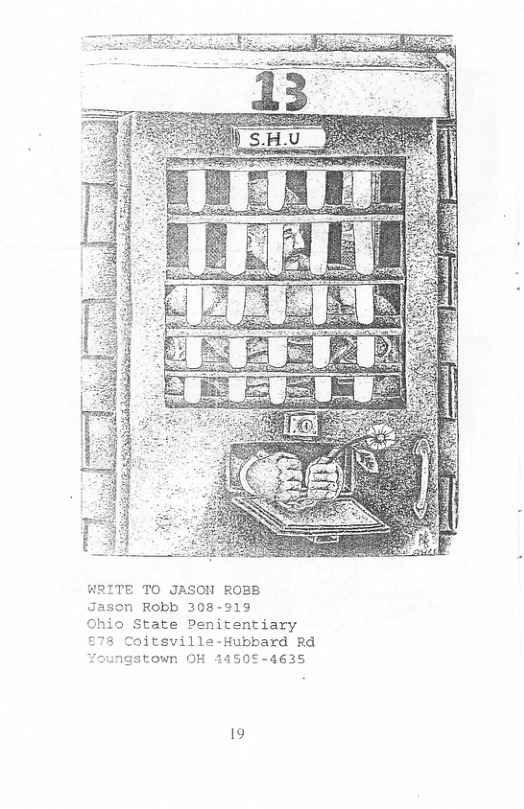
TE TO JASON ROBB
on Robb 308-919
19
WHY DON'T WE KNOW EACH OTHER?
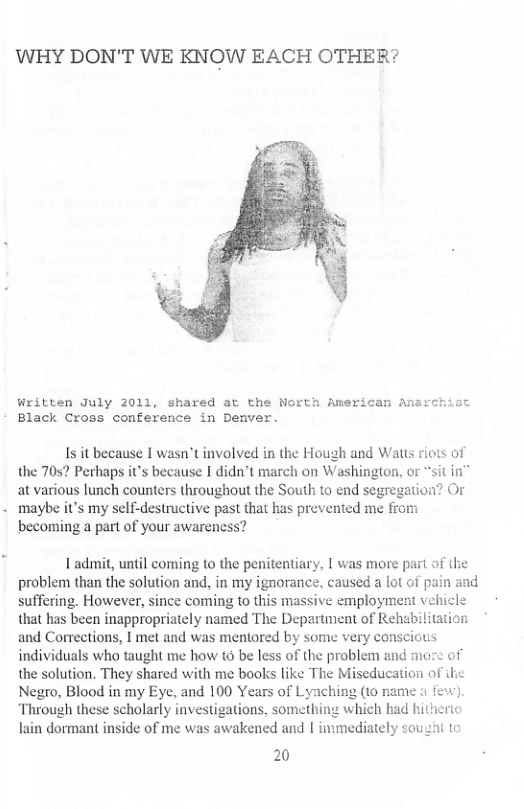
written July 2011, shared at the North American Anar
Black Cross conference in Demver.
I it because I wasn’tinvolved in the Hough and Watts riots of
the 705? Perhaps it's because I didn’t march on Washington, or “sit in”
at various lunch counters throughout the South to end segregation” O
maybe it's my self-destructive past that has prevented me from
becoming a part of your awareness?
1 admit, until coming to the penitentiary, | was more par
problem than the solution and, in my ignorance. caused a lot of p
suffering. However, since coming to this massive employment vehicle
that has been inappropriately named The Department of Rehabilitation
and Corrections, I met and was mentored by some very conscious
individuals who taught me how t6 be less of the problem and moze of
the solution. They shared with me books like The Miseducation of the
Negro, Blood in my Eye, and 100 Years of Lyaching (to name & ferw)
Through these scholarly investigations. something which had hitheric
lain dormant inside of me was awakened and | immediately souzhi 1o
20
share my newfound awareness with those around me in hopes that we,
together. could change the oppressive environment that we were living
in. Some would insist that by becoming aware of my surroundings and
challenging the policies of those in power I became a “political
prisoner.” [ would say that | was simply living on the knowledge of my
experience. If that makes me a political prisoner, I can neither confirm
nor deny it. It is what it is.
In 1993, a major prison uprising erupted at the Southern Ohio
Correctional Facility (SOCF) in Lucasville, Ohio. In its aftermath, I and
several of my comrades were indicted for allegedly orchestriting,
ordering, and, in some cases, participating in the hands-on killing of
several inmates who were suspected of being informants. However, as
the trials got underway. it very quickly became apparent that certain
people were being singled out, not because of our actual involvement in
crimes committed during the disturbances but because of our political -
views and the potential danger we represented. Unbeknownst to us at
the time. we were singled out and used to form the basis for the building
of a new supermax prison in Youngstown, Ohio.
Although this is not the proper forum to rehash the particulars of
our situation, it should suffice to say that the miscarriages of justice that
occurred during our collective trials and appeals were so flagrant and
egregious that several books (namely, Lucasville: The Untold Story of a
rison Uprising), a play, and a full-scale documentary (Dark Little
Secrets) have been created to expose our plight to the public. |
encourage each and every one of you to seek out these sources of
information and acquaint yourselves with the reality of our situation and
then decide whether or not we are political prisoners deserving of your
support and recognition. In the meantime; understand that whether or
not we vrin your allegiance, there are thousands of men and women
inside these places who are right now rising to the occasion that
confronts all of us who, as human beings, are living under a totalitarian
government. Through trial and error, we are engaging in work stoppage
(Georgia). hunger strikes (California and Ohio) and various other forms
of civil disobedience designed to challenge and change the status quo.
21
With this in mind, I end as I began, by asking: why do
know each other?
Freedom first,
Coong,
WRITE TO GREG CURRY
Greg Curry 213-159
Ohio State Penitentiary
878 Coitsville-Hubbard Rd
Youngstown, OH 44505-4635
3
' 15 was a rebellion against oppressive
ies at the Southern Ohio Correctional
in Lucasville, OH. Nine inmates and one
G the uprising in April of 1993. Today,
secple are serving time or condemned to death by the
of Ohio in relation to the uprising. We demand
y and freedom for all of these inmates. The
(and still are) intolerable and
onditions at SocF
inconscionanle South Chicago ABC
;i Zine Distro
distributed by:
‘l P.O. Box 721
=y
RE D BI 21) Homewood, IL 60430
St PO BOX 1291
Columbus Oh 43216 ]
PRISO
redbirdprisonabolition.org
ibutors this zine do mot support the various
alleged 2ffiliations of the prisomer contributors to this
but strongly support their stand against government
and will do what we can to amplify their
shown by prisoner resistance nationally there
ok past individual beliefs and alleged
to stand together. Unity takes away the
lay puppet masters and places
= enlightened prisoners who choose not
These prigoners' united stand across
ns and under the most trying of
uld be an sxample and inspiration to us
FREE ALL PRISONERS
The aistr